
Chapelle Dorée Publishing Store
What We Found Last Summer (e-book)
What We Found Last Summer (e-book)
👉 Get it on Amazon
Secure checkout via Amazon
'80s nostalgia meets suburban noir.
There's a moment when childhood ends,
but you just don't know it yet.
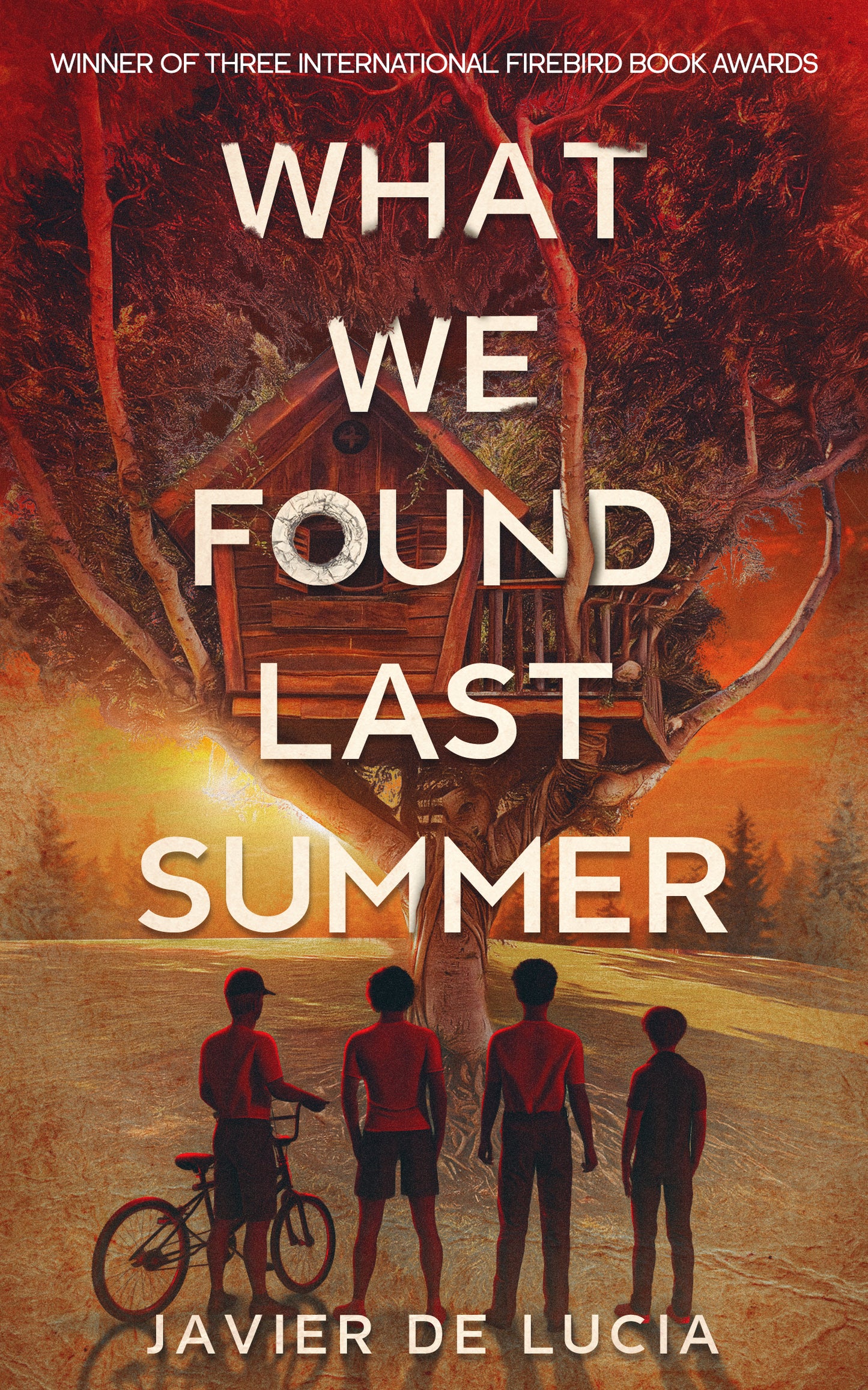
When twelve-year-olds Calvin and Derek venture to an abandoned treehouse at the edge of the woods, they stumble across something they were never meant to see.
What begins as another carefree summer day—when friendship feels permanent and nothing really matters—quickly turns into something far more serious as the boys realize they’ve brushed up against a world of crime, danger, and secrets that don’t belong to kids.
Some summers you never forget.
Others change you forever.
Read a free preview on Reedsy Discovery.
Share
What We Found Last Summer — Official Book Trailer

Winner of 3 First Place International Firebird Book Awards
- Coming of Age
- Novella
- Best Evolution of Style

Editorial Reviews
-
⭐⭐⭐⭐⭐
What We Found Last Summer is a compact, propulsive coming-of-age thriller built around a very 1980s kid-adventure setup: bikes, woods, fireworks, treehouses, comics, neighborhood rivalries, and parents who are just far enough away for trouble to bloom. The hook is simple and effective: Calvin and Derek find a bag of mob money in an abandoned treehouse, and their summer suddenly becomes much bigger than scraped knees and boyhood dares. The book knows exactly what it’s playing with when it invokes “Kids on bikes,” but it gives that familiar shape a sharper adult edge.
What makes the story work is that it isn’t just nostalgia dressed up as danger. Author Javier De Lucia fills the neighborhood with specific, lived-in relationships: Calvin and his brother Ryan, Calvin and Ravi’s strained friendship, Derek’s restless bravado, Rochelle’s divided loyalty, Lolo’s quiet vigilance, and the uneasy presence of adults whose choices are spilling into the kids’ world. The mob plot gives the novel momentum, but the real texture comes from the way every kid is trying to understand power, loyalty, fear, and belonging with only a twelve-year-old’s emotional toolkit.
The tone is probably the book’s strongest asset. It’s funny in a blunt, profane, very character-driven way, and then it can turn tense fast without feeling like it has changed books. Agent Baker’s line, “We follow the money,” could’ve been pulled from a straight crime novel, but here it sits beside comic-book arguments, treehouse engineering, and kids making decisions they’re nowhere near ready to make. That mix gives the novel its personality: half suburban adventure, half crime story, with the two halves rubbing against each other in interesting ways.
I also liked how the book lets the kids be messy without sanding them down into symbols. Calvin is cautious but tempted, Derek is bold but scared, Ravi is annoying because he’s often right, and Rochelle sees more than the adults realize. Lolo, meanwhile, becomes one of the book’s most memorable presences because he understands the danger before the kids fully do. The story has a real affection for childhood imagination, but it’s also honest about how quickly imagination can collapse when actual violence enters the frame.
By the end, What We Found Last Summer feels like a memory that’s been sharpened into a pulp adventure, then complicated by an adult narrator who knows memory and fiction don’t always sit in separate rooms. The afterword’s idea that “Everything counts” fits the book nicely, because this is a story about the way childhood incidents can become myths, wounds, jokes, and origin stories all at once. It’s a fast read, but it has more going on than its premise suggests, and its best moments come from how confidently it treats a neighborhood summer as something big enough to change everyone who lived through it. -
⭐⭐⭐⭐⭐
Best friends Calvin and Derek don’t view their daily activities as reckless; to them, it’s just the standard chaos of boyhood adventures in their Connecticut town. A treehouse assembled with questionable construction techniques? Pretty solid work for 12‑year‑olds. Setting off fireworks with no adults in sight? A typical Fourth of July. Stirring up another round of trouble with the vindictive Eicher boys? A longstanding tradition. So when Calvin and Derek hear about an abandoned treehouse at the far end of the woods, they assume it’s just one more adventure they’re built to handle. They know every inch of the woods near Calvin’s house, so exploring a little further is what summer is made for. What begins as a scavenging expedition to shore up their own treehouse takes an exciting turn when they find a bag of cash tucked in an old steamer trunk. Derek, as expected, claims the funds under the standard finders-keepers law. Calvin tries for diplomacy and level-headedness, leaning toward parental or police involvement. Before the boys can reach a consensus on what to do with the money, the Eichers catch wind of their find. However, neighborhood squabbles and decisions about frivolous spending pale in comparison to the debt owed by the one who hid the cash in the first place. Trouble comes knocking, and the mob is at the door. And mobsters don’t take kindly to anyone taking what’s theirs, even if it is a bunch of kids.
What We Found Last Summer is like a mystery-tinged time capsule that transports readers to an era before bicycle helmets and cultural awareness. The small-town setting and preteen cast are an homage to classic coming‑of‑age tales where curiosity outruns caution, bike rides are stories waiting to write themselves, and life always catches up to you. De Lucia’s effortless writing style pulls audiences back into the energetic headspace of young boys who have no filter, no fear, and no sense of how big the world really is. Adolescent priorities, like arguing over the finer points of comic‑book art while thousands of dollars hang in the balance, capture the preteen years with nostalgic clarity. The story steadily gains momentum, climbing toward a compelling peak with unexpected ramifications. Though the resolution arrives quickly, make sure to stay for the ultimate finale, as it recontextualizes Calvin’s story and adds a layer of maturity to the novel. If you loved the raw honesty and lingering consequences of King’s The Body, you’ll be swept up by De Lucia’s quintessential buddy novel, What We Found Last Summer, a memorable tale about moments that leave a mark.
- R.C. Gibson, Indies Today
-
⭐⭐⭐⭐⭐
What We Found Last Summer by Javier De Lucia follows twelve-year-olds Calvin and Derek as they try to enjoy a carefree summer in their quiet Connecticut suburb. The summer has a distinctly 1980s feel as they build treehouses, ride their bikes, and hang out with their friends, Ravi and Ryan. Then they stumble upon a bag of money in an abandoned treehouse, and everything changes. At first, it’s just a secret adventure, but the cash belongs to a local mobster, and suddenly their summer is filled with threats and adults who don’t play fair. The kids must figure out what’s the right thing to do while dealing with neighborhood bullies, dangerous mob enforcers, and law enforcement watching their every move. The story follows them as they make decisions they don't fully understand, and the tension never lets up. Their journey shows what happens when childhood collides with the adult world. Will they ever feel safe again when almost everything around them is dangerous?
Javier De Lucia’s What We Found Last Summer is a compelling coming-of-age tale that’s hard to put down. The pace keeps you on edge even when nothing explosive is happening. Casual moments, like the kids sneaking through the woods, arguing over a treehouse, or avoiding their bullies, carry real suspense because you know what's really at stake. Even when the mob enforcers appear, the danger feels immediate. De Lucia doesn’t need long fight scenes or chase sequences; he simply puts the kids in situations where one wrong move could cost them everything. The suburban world is familiar, with quiet streets, backyards, and a mix of personalities, but it's layered with risk because of the adults' secret lives. The juxtaposition of mundane summer life with hidden criminal activity makes the suspense authentic, almost like you're watching children tiptoe through a world filled with dangers far beyond their years. By the end, you feel every life-changing decision, every misstep, and how a single summer can change everything for Calvin and his friends forever. Recommended.
- Richard Prause, Readers' Favorite
-
⭐⭐⭐⭐⭐
Must read 🏆
An investigation into gang activities led by Agent Baker entangles innocent bystanders
If there’s one thing Javier De Lucia’s short novel, What We Found Last Summer, reminds us about, it’s that Boys will always be boys. That’s because Javier’s protagonists are boys, and they’re at it again. They love hanging out together in their treehouse, but this time they’re out to explore. They’re headed to the woods. What can possibly go wrong?
Soon enough, a disturbing discovery prompts them to ask weighty questions among themselves. Should they contact the police? Or keep the secret to themselves. Considering that the Mob could be involved, the boys must act fast.
Following teenagers in their prime, Javier brings the other characters on board as well: the parents, the police, the bad guys, and, of great interest, the community upon which the narrative unfolds. In this community, people know each other well enough, talk about each other, and you can’t walk by unnoticed.
The plot is playful at first, and Calvin’s crew puts one in mind of their childhood days. As the plot progresses, it goes all too well until the boys stumble upon an abandoned treehouse, and curiosity gets the better of them.
With evocative prose, Javier assembles engaging characters and constructs a plot that gets intense with time. The boys, having found themselves in trouble, equally and actively contribute to finding a solution. Sammy needs money for his ear surgery, screaming, “We’re gonna fix my ears!” He’s the reason a bullet is fired. In the meantime, Rochelle is caught between saving her dad and her friends, eventually making the right decision. Lolo can't allow any harm to the children, and he knows crooked characters when he sees them.
The inciting incident doesn’t take long, and before it arrives, Javier keeps the readers guessing, making the narrative an exciting read, a journey worth exploring. The epilogue not only explains a lot but also adds a bit of mystery to it, arousing more questions while lending the story a firm grip.
Overall, What We Found Last Summer is highly recommended.
- Emily Omondi, Reedsy Discovery
-
⭐⭐⭐⭐⭐
What We Found Last Summer is a young adult crime drama by Javier De Lucia. Best friends Calvin and Derek love venturing into the woods with their friends, Ravi and Ryan. However, when the two friends come upon an abandoned treehouse deep in the woods, they stumble upon a brown paper bag full of money. Not knowing any better, they retrieve the bag and bring it home. But they don't realize that the money belongs to the mob. Meanwhile, their rivals, the Eicher boys, get hold of the bag, and now, the mob guys are after them. After one of the Eicher brothers gets shot, Calvin and Derek realize that their own lives are in danger. What's next in store for them?
A seamless mix of suspense, adventure, and action makes What We Found Last Summer an absolute joy to read. This is the perfect crime adventure for teenagers and young adults. It's short, action-packed, and full of surprises. The pages flew by for me, as Javier De Lucia doesn't waste a single word and spins an absorbing plot from start to finish. The author drops the reader in the midst of the action from the get-go, and it's a wild rollercoaster of a ride from there. I was completely invested in the story arcs of the main characters. They are likable and have distinct personality traits that leave a mark on the reader. You can really feel the stakes as no one is truly safe in the story. Overall, I thoroughly enjoyed the book, and you will too!
- Pikasho Deka, Readers’ Favorite
-
⭐⭐⭐⭐⭐
In the suburban neighborhoods of Southwest Connecticut, four young boys—Calvin, his small brother Ryan, Derek, and Ravi—are scouring for wood for their treehouse when they stumble upon money hidden in a package. They take the money. Soon, they learn that two members of the mob are looking for the money. It turns out their friend Rochelle’s parents are in trouble with the mob over the missing money. The boys want to return the money, but there is one huge problem. Other kids had raided their tree house and stolen the money. As they try to get it back, they witness a crime that not only puts their lives in danger but is also about to change things. Find out more in What We Found Last Summer by Javier De Lucia.
If you are looking for a young adult crime novel laced with suspense and a splash of action and drama, What We Found Last Summer by Javier De Lucia is a perfect pick. With a dramatic introduction, De Lucia weaves a short, enthralling tale reminiscent of childhood and preteen experiences, exposing the danger in the mischief associated with the latter. The lively conversations and introspective thoughts reveal the social dynamics that kids and preteens navigate, and how these shape their characters and lives. Derek is the embodiment of a bad influence. Only twelve, he is also the reason the boys take the money, albeit reluctantly. However, his character highlights the impact of this type of upbringing on children. The story warns kids against taking what does not belong to them; instead, it urges them to inform adults or law enforcement.
- Keith Mbuya, Readers’ Favorite
-
⭐⭐⭐⭐⭐
In What We Found Last Summer by Javier De Lucia, Agent Baker and his partner were on a drug task force. Their efforts were yielding results and had been focused on a suspect, Tony, for a while now. Agent Carter wants to arrest him, but Baker wants to follow him so he can lead them to the source of the money financing the drugs. Meanwhile, three kids are building a tree house and want to explore another abandoned tree house for materials to build their new tree house. When they get to the abandoned tree house, they discover a bag full of money hidden there. As things unfold, Calvin and his friends lose the money to another rival group of boys. Tony gets in a lot of trouble with his gangster friends, but the boys with the money are soon discovered. How will things unfold, especially after a child is shot as the gangsters try to retrieve their money?
What We Found Last Summer by Javier De Lucia is a story that, once you start reading it, there is no putting it down. The writing is crisp, engaging, and filled with well-crafted dialogue that brings the events to life. This amazing work shows the need to protect kids, and the thought-provoking work also got me thinking about how something small can get out of control. The pacing was steady, and Javier also ensured all events and places were vividly described, which helps to capture the imagination of the reader. The characters were well-developed, and the reader will also appreciate the seamless flow of the plotline. This was an amazing read, and I look forward to more books by Javier De Lucia.
- Frank Mutuma, Readers’ Favorite
-
⭐⭐⭐⭐
What We Found Last Summer by Javier De Lucia is a short YA coming-of-age story. Derek and Calvin are heading to an old treehouse for a carefree day of fun and friendship, but what they find isn’t what they expected. The treehouse should have been empty, but there are signs that someone has been there. There’s something in the treehouse that shouldn’t be there, something they should never have seen, and it puts them firmly in the sights of a criminal gang. Now their lives are in danger. Will they escape with their lives?
What We Found Last Summer by Javier De Lucia is a bit different from the usual coming-of-age story. It’s told from several perspectives, each chapter from the point of view of one group of characters, which does give you the full story. The characters are well-developed, and despite it being a short story, you do get to know them. It’s got plenty of action in it, some bad language, and a shooting scene, but nothing in graphic detail, and not unexpected given that it's told from the perspective of young teens. It is about growing up, about facing things you are perhaps too young to understand at the time, but being forced into a situation where you have to make the right choice for survival—physically and metaphorically. The ending comes as a surprise and gives the story a little more meaning. Overall, an enjoyable read for anyone who likes a short story with a twist in the tail.
- Anne-Marie Reynolds, Readers' Favorite
-
⭐⭐⭐
Pure tribute and nostalgia from Javier. A dramatized throwback to his childhood years of Spielberg movies and a life before you really grow up – though this has definitely more in common with Stephen King’s “The Body” (which became the movie Stand by Me) than The Goonies. I don’t know how much of this tale is real, fictionalized or based on hearsay from Javier’s own childhood, but it is one of those crime stories which pop up often in fiction and rarely in real life; although, of course, such things happen. Instead of a body, it is a bag of mob cash the pre-teen kids find, between their antics of BMX-ing, treehouses and baseball cards. It is total Americana, and I have to say I quite enjoyed it.
That said, I’ve read a few from Javier, of whom I’m a big fan, and I wouldn’t say this one hits anywhere near the high notes I know he’s capable of. There are a few reasons for this. Firstly, it is of course a novella, rather than a novel, and a pretty short one at that, at only 16,000 words; I read it in an hour or two, so don’t expect to be fully immersed in either the characters or the narrative. It is short, easy reading, for no other purpose than killing time with entertainment. That’s absolutely fine, of course, and in fact there isn’t a great deal more meat on this story to enable drawing it out. That said, Javier is usually a masterclass in character development and engagement. In other books of his I’ve read, you don’t just empathize with the characters, you become them, and feel every moment of their coming of age. I assume that the lead in this story, Calvin, is the same Calvin in his epic Wake of Expectations saga, although I might be wrong. If he is, then this offering has a completely different pace and tone, as a direct prequel. I would suggest that it be included in a volume of three or four loosely themed shorts (as indeed King’s is); I know this excellent author has it in him to produce. Additionally, I would like to know a little more about the fact on which it is based, if indeed that is the case. Considering the villains of the piece, I think a little more grime and genuine danger might be expected.
In short, the story covers a few elements, though none particularly deeply. We don’t get heavily invested in any of the characters, the plot or indeed the threat. It is simply a brief, fun, coming-of-age crime tale. Give it a go, but don’t think it represents Javier, because he is profound, cerebral and utterly engrossing; this one perhaps could just do with a sprinkle of grit.

Featured Commentary
-
Book Review of: What We Found Last Summer
"What We Found Last Summer," by Javier De Lucia is a poignant and evocative exploration of the fragile boundary between childhood innocence and the encroaching shadows of adulthood. In a summer of treehouses and 80s anthems, the greatest discovery wasn’t hidden in the woods—it was the moment innocence died. Javier De Lucia delivers a hauntingly nostalgic masterpiece where childhood wonder collides with a violent adult reality, proving that the things we find in our youth are the very things that define our future. Set in the suburban landscape of southwest Connecticut, the narrative captures a specific brand of 1980s nostalgia that feels both universal and intimately personal. De Lucia crafts a world where long summer days are defined by the sanctuary of a handmade treehouse and the bonds of a close-knit group of friends, including Ryan, Matty, and Calvin.
The story masterfully utilizes cultural touchstones—ranging from "The Goonies" and "Stand by Me" to the music of the era—not merely as window dressing, but as a lens through which to view the characters' burgeoning self-awareness. This innocence, however, is precarious. While the boys navigate the "messy middle" of growing up, a darker reality is closing in. The adult world, represented by drug enforcement agents Baker and Carter, is actively tracking local criminal elements like Tony San Giacomo, a man whose illicit influence permeates the neighborhood.
The tension culminates in a singular, violent moment when a gunshot shatters the peace of their wooded retreat, forcing the boys to confront the fact that their childhood games have ended. De Lucia’s prose is defined by an "ironic grace" and "emotional depth," ensuring that the transition from play to peril feels both inevitable and heartbreaking. As a "story within the story" of the larger Becoming Calvin series, this novel serves as a vital bridge between the coming-of-age epic. The Wake of Expectations and the Introspective A Pleasant Fiction. It invites readers to find the "extraordinary hidden within ordinary life" while grappling with themes of grief and resilience.
This is a story that is ideal for readers who cherish literary coming-of-age tales with a dark twist, similar to the works of Stephen King. It will resonate deeply with those who enjoy character-driven narratives that explore the lasting impact of childhood memory, grief, and the choices that shape who we become.- Reviewed by Carol W. for AuthorsReading.com
-
-